The 1-Million-Token Leap of Google Gemini 4 (Argon)
Launch of Google Gemini 4 (Argon), examining its breakthrough 1-million-token output capacity, autonomous cybersecurity features, pricing models, and how it stacks up against competing architectures from OpenAI and Anthropic.
3 min read · San Francisco, USA
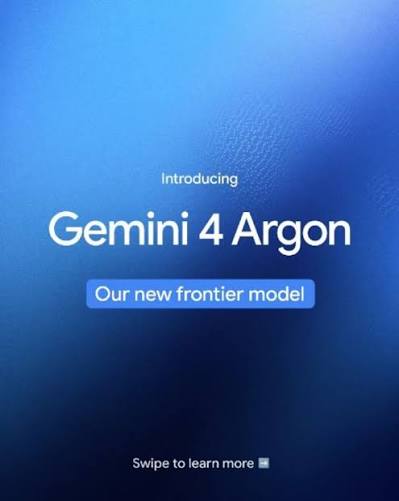
The race has officially pivoted away from passive conversation and toward autonomous execution. Following months of intense industry anticipation, Google DeepMind has officially torn back the curtain on its next-generation architecture, introducing its flagship frontier model: Gemini 4 (releasing first under the configuration designation Argon).
Designed from the ground up for heavy-duty software engineering, complex multi-step knowledge workflows, and advanced defensive cybersecurity, Gemini 4 marks a structural break from previous model iterations. Rather than simply optimizing for faster chat prompts or marginal benchmark gains, Google has engineered an AI designed to operate for hours across massive horizons without losing its institutional memory.
What’s New: The Engineering Breakthroughs
Gemini 4 Argon introduces several landmark capabilities that redefine what large-scale frontier models can achieve in a single workflow:
The 1-Million-Token Output Ceiling: While previous iterations and competitive models typically bottleneck output generation between 64K and 128K tokens, Gemini 4 Argon shatters this barrier by supporting up to 1 million output tokens in a single pass. This massive leap gives the model enough operational headroom to execute complex reasoning trajectories without forcing developers to chunk, stitch, or restart interrupted processes.
Autonomous End-to-End Codebase Migration: Inside Google, Gemini 4 agents have already been deployed to handle monumental technical debt, migrating massive codebases from legacy C/C++ to memory-safe Rust. This includes rewriting hundreds of thousands of lines of code for core infrastructure libraries and OS kernels with minimal human intervention.
Native Multimodal and Long-Video Reasoning: Moving far beyond static text and basic image parsing, Argon integrates state-of-the-art vision processing, scoring leading marks on long-video comprehension benchmarks (such as 91.7% on LVBench) and complex visual chart analytics.
Advantages and Disadvantages: The Balance Sheet
The Advantages
Elimination of Context Fragmentation: Because the model can maintain an unbroken chain of thought across millions of input and output tokens, it avoids the "lost in the middle" degradation that historically plagued long-context applications.
Defensive Cybersecurity and Automated Patching: Launched initially through restricted programs like the Fairwind Program for trusted cyber defenders, Argon is capable of autonomously identifying vulnerabilities, crafting patches, and running validation routines on live networks.
Aggressive Introductory Pricing: Google has aggressively priced the model’s API entry tier at $2 per million input tokens and $10 per million output tokens, undercutting higher-priced legacy alternatives before shifting to standard rates ($4/$20).
The Disadvantages
Staggered, Restricted Access: Unlike consumer-facing drops, Gemini 4 Argon is not initially available via a broad public chat interface. It is rolling out selectively to enterprise clients, trusted security partners, and select API users, locking out casual developers.
The Cost of Length: While per-token pricing looks competitive, running continuous 1-million-token reasoning loops creates a steep financial risk. Unmonitored agentic workflows can rapidly run up significant cloud compute invoices if not meticulously managed.
Verification and Drift Hazards: Even with built-in chain-of-thought monitors, autonomous models operating across extended horizons carry the risk of silent logical drift, requiring rigorous human oversight for critical code deployments.
The Data Matrix: Benchmarks and Market Position
Google’s internal and independent evaluations position Gemini 4 Argon at the absolute bleeding edge of the industry, going head-to-head with OpenAI’s GPT-6 ecosystem and Anthropic’s Claude 5 line.
Gemini 4 Argon vs. Industry Competitors: Core Metrics
---------------------------------------------------------------------------------
Evaluation Parameter Gemini 4 (Argon) OpenAI (GPT-6 Astra/Sol) Anthropic (Opus 5.5)
---------------------------------------------------------------------------------
Max Output Token Limit 1,000,000 Tokens 128,000 Tokens 64,000 - 128,000 Tokens
Primary Architecture Focus Enterprise & Cyber Sec General Reasoning & Code Advanced Enterprise Prose
Security Vulnerability (CWE-bench v1) ~68.0% (Tie) ~68.0% (Tie) ~67.0%
Introductory API Pricing $2 In / $10 Out (per 1M) Variable by tier Standard tiered scaling
---------------------------------------------------------------------------------
*(Sources: Compiled from DataCamp technical audits, developer disclosures, and benchmark aggregators.)*
The Competitive Landscape
The timing of the Gemini 4 launch is no coincidence. Dropping immediately on the heels of major updates from competing labs such as OpenAI's iterative enterprise pushes and Anthropic's deep-reasoning releases Google’s strategy represents a clear escalation in the AI wars.
While competitors have focused heavily on mid-tier cost optimization or conversational latency, Google has staked its claim on autonomous deep labor. By targeting the heavy lifting of software refactoring, automated security auditing, and cross-document data automation, Gemini 4 shifts the competitive battlefield away from chatbot cleverness and toward industrial productivity.
The question facing enterprises is no longer whether models can reason, but whether organizations are ready to hand over millions of lines of code and operational infrastructure to an autonomous agent capable of rewriting them in a single pass.
Technology reporter. AI, chips, platforms and the people building them.
Comments (0)
Comments are turned off for this story.