UNEP’s Landmark Warning on the 1.5°C Threshold
UN Environment Programme’s stark warning that Earth is set to surpass the 1.5°C warming threshold, detailing the mathematical exhaustion of global carbon budgets
3 min read · Mexico City, Mexico
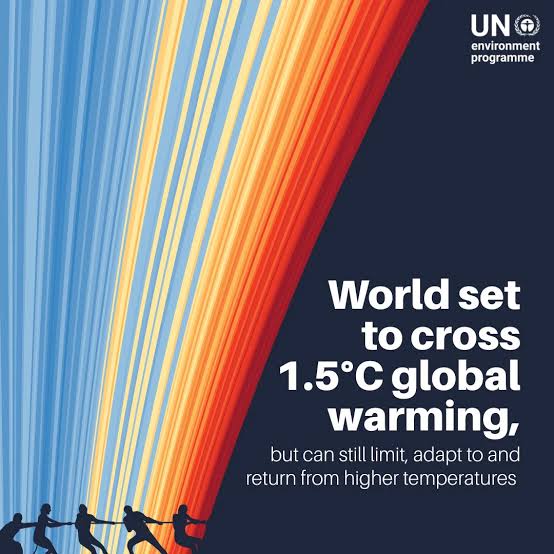
For nearly a decade, the 1.5°C warming target enshrined in the Paris Agreement has functioned as the ultimate boundary marker for global climate action a bright red line separating manageable environmental disruption from systemic, irreversible planetary collapse. That boundary has effectively crossed from a prevention target into an impending reality.
In a landmark report titled Limiting Overshoot, the United Nations Environment Programme (UNEP) delivered a sobering and definitive assessment: the world is now mathematically and operationally set to surpass the critical 1.5°C global warming threshold within the coming years. Moving past decades of diplomatic prevarication, the UN framework has shifted its focus from how to avoid the breach entirely to how humanity must survive, minimize, and eventually reverse a dangerous multi-decadal "overshoot".
The Math of the Breach: Why 1.5°C is No Longer Avoidable The structural reality forcing the UN's hand is rooted in raw carbon math. To permanently hold warming below 1.5°C relative to pre-industrial levels, cumulative global carbon dioxide emissions from 2026 onward cannot exceed a strict remaining budget of roughly 130 billion tonnes.
With global greenhouse gas emissions hovering near 40 billion tonnes annually and failing to decline at the necessary scale, that remaining budget will be effectively consumed within a few short years.
UNEP Warming Projections and Trajectory Milestones
---------------------------------------------------------------------------------
Metric / Indicator Historical / Current Baseline Projected Trajectory
---------------------------------------------------------------------------------
Current Global Emissions ~40 Billion Tonnes CO2/Yr Plateauing / Slow Decline
1.5°C Budget Exhaustion Imminent (Next few years) Unavoidable multi-decadal breach
Best-Case Peak Scenario Single-year spikes past 1.5°C Peaking at ~1.8°C above baseline
End-of-Century Path (Policies) Current national pledges Reaching 2.3°C to 2.6°C warming
---------------------------------------------------------------------------------
*(Sources: Compiled from UNEP Emissions Gap and "Limiting Overshoot" reports.)*
As the data outlines, even under the most optimistic policy implementation frameworks assessed by UNEP, global temperatures are projected to peak at a minimum of 1.8°C above pre-industrial levels before any theoretical cooling trajectory can take effect. Under unmitigated current national policies, the planet remains on a trajectory toward 2.3°C to 2.6°C by the end of the century.
The "Overshoot, Peak, and Decline" Paradigm
Because avoiding the threshold has slipped out of reach, UNEP’s analysis pivots entirely to an "overshoot, peak, and decline" framework. This strategy acknowledges a grim sequence of events: The Exceedance Phase: Global temperatures will climb past 1.5°C for a sustained multi-decadal average, triggering severe environmental tipping points.
The Mitigation Floor: Aggressive, unprecedented decarbonization—requiring annual emissions cuts exceeding 7.5% year-over-year—must be forced onto the global economy to cap the peak temperature as low as possible (ideally around 1.8°C).
The Long Return: Massive deployment of carbon dioxide removal (CDR) technologies and absolute net-negative emissions would then be required in the second half of the century to drag global temperatures back down below the 1.5°C ceiling.
UNEP officials are blunt about this shift: an overshoot pathway is by no means an acceptable or preferred strategy. It is a high-risk gamble loaded with ecological unknowns. Every fraction of a degree that temperatures rise above 1.5°C exponentially compounds the risk of irreversible feedback loops—including the collapse of major ice sheets, the die-off of coral reefs, and massive permafrost methane releases.
The Geopolitical and Economic Friction
The UN’s acknowledgment that the world is entering "uncharted territory" exposes a profound friction between international scientific warnings and domestic political realities.
While international climate summits routinely produce consensus agreements to transition away from fossil fuels, the national implementation plans (Nationally Determined Contributions) submitted by major economies fall drastically short of the steep reductions required. Financial capital flows into clean energy are hitting record highs, but they are still being outpaced by baseline global energy demand and stubborn fossil fuel extraction.
For frontline vulnerable states particularly low-lying island nations in the Pacific the formal acknowledgment of an inevitable overshoot is not just an academic policy update; it is an existential alarm. As temperatures breach the 1.5°C line, adaptation finance, loss-and-damage funds, and aggressive climate resilience measures move from diplomatic talking points to the absolute front lines of human survival.
Sources
Business and climate correspondent covering how economic policy shapes the energy transition.
Comments (0)
Comments are turned off for this story.